
The Pier & Coastal Private 5G Deployment
overview
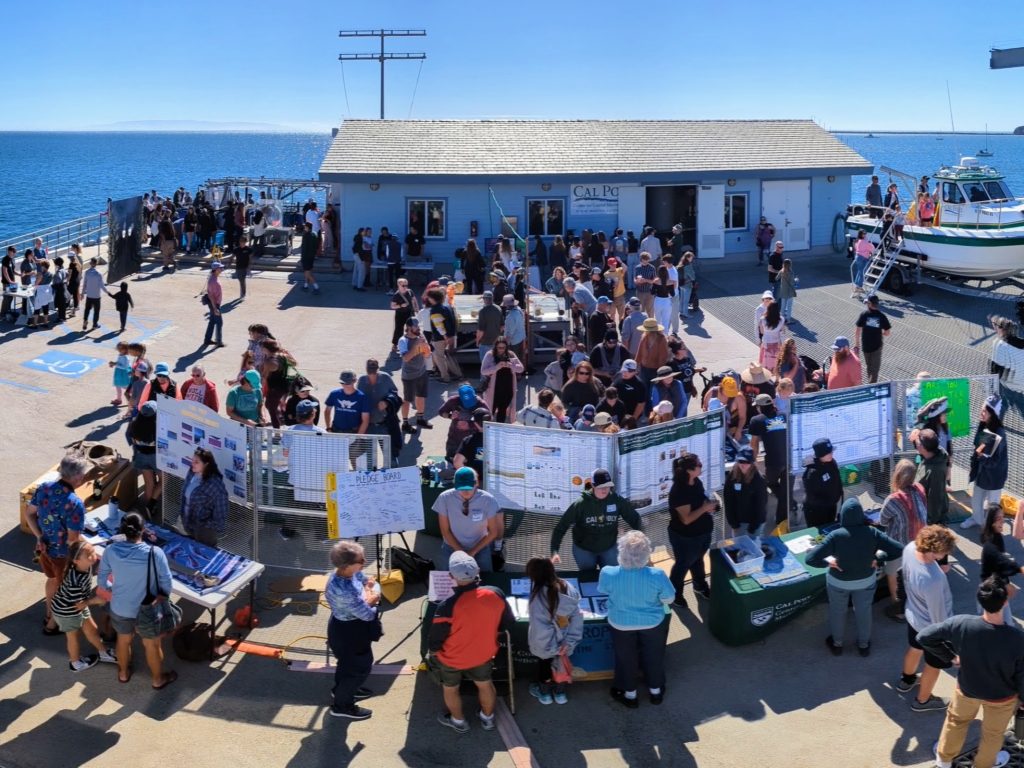
Cal Poly’s Advanced Wireless Lab has expanded its private 5G infrastructure to one of the most challenging connectivity environments in its ecosystem: the marine research Pier.
Located along California’s rugged central coastline, the Pier supports marine science, environmental monitoring, underwater robotics, and field-based education. Yet for years, it faced a persistent infrastructure challenge unreliable cellular coverage, limited bandwidth, and no dependable platform for real-time data exchange.
With the deployment of a CBRS-based private 5G network, Cal Poly has transformed the Pier into a fully connected marine research node bringing carrier-grade wireless performance to the edge of the Pacific Ocean.
This is coastal infrastructure reimagined.
The Challenge
Remote coastal research facilities operate in a uniquely difficult environment:
- Weak or inconsistent public carrier signals
- Salt-air corrosion impacting traditional telecom hardware
- No direct fiber redundancy
- Limited backhaul capacity
- High data demands from marine instrumentation
Researchers at the Pier rely on:
- Underwater drones and remotely operated vehicles (ROVs)
- Real-time oceanographic sensors
- Live video feeds
- Environmental monitoring arrays
- Field-based collaboration with campus laboratories
Without reliable connectivity, mission-critical research workflows are slowed, delayed, or manually retrieved.
Traditional commercial carriers prioritize urban population centers. Coastal research infrastructure often falls outside of high-density service zones.
The solution required ownership and control of the wireless layer.
The Private 5G Solution
By deploying private 5G on the CBRS spectrum, Cal Poly now controls:
- Coverage zones
- Network performance
- Security architecture
- Bandwidth prioritization
- Latency optimization
Unlike public cellular networks, this infrastructure is purpose-built for research performance which is not a consumer traffic.
The Pier’s private 5G node integrates directly with campus core systems, forming a secure and seamless extension of the university’s wireless backbone.
Why Private 5G Instead of Traditional Connectivity?
Private 5G provides advantages that Wi-Fi and public LTE cannot match in this environment:
- Greater coverage range over open water
- Dedicated bandwidth for mission-critical data
- Improved reliability in harsh conditions
- Network slicing and prioritization capability
- Secure device authentication and isolation
As Cal Poly’s Vice President for IT Services and CIO noted:
“It would cost $20 million to re-fiber the whole campus. Now a new building might get a 5G drop instead.”
At the Pier, that “5G drop” means researchers can:
- Stream live underwater drone footage
- Transmit environmental data in real time
- Maintain stable voice and data communications
- Access campus computational resources from the field
Without depending on commercial carrier availability.
Strategic Network Advantages
Edge-of-Connectivity Infrastructure
The Pier represents one of the most geographically challenging deployment sites in Cal Poly’s portfolio. Successfully extending private 5G here demonstrates the scalability of the Advanced Wireless Lab’s infrastructure model.
Seamless Campus Integration
The Pier’s 5G node integrates into the same campus private wireless core supporting:
- Frost Hall
- Poly Canyon
- Swanton Ranch (BEACON)
- Paso Airport Spaceport Corridor
Researchers and students remain on a unified, secure network — even at the ocean’s edge.
Marine-Optimized Deployment
The installation accounts for:
- Salt-air durability
- Coastal wind exposure
- Corrosion-resistant hardware
- RF propagation across open water
This is not a standard campus rooftop deployment. It is engineered for coastal resilience.
High-Impact Applications
Marine Science & Environmental Monitoring
Oceanographic sensors transmit real-time data to campus laboratories for analysis, modeling, and archiving. Data no longer waits for manual retrieval.
Underwater Robotics & Live Video
ROVs and marine drones stream live high-definition video feeds over private 5G, enabling real-time collaboration between field teams and on-campus researchers.
Field-Based Learning
Students conducting marine research remain fully connected — able to access cloud systems, collaborate with faculty, and operate instrumentation without connectivity constraints.
Emergency & Coastal Operations Support
Reliable connectivity enhances situational awareness and communication capabilities in case of coastal emergencies, severe weather events, or environmental incidents.
Powered by Strategic Partnerships
The Pier deployment is part of Cal Poly’s broader private 5G modernization strategy, developed in collaboration with:
- AWS
- Federated Wireless
- T-Mobile
These partnerships allow the Advanced Wireless Lab to implement carrier-grade architecture while maintaining institutional control over deployment and operations.
Supporting Environmental Diversity
Cal Poly operates across one of the most environmentally diverse university landscapes in the country:
- Coastal marine ecosystems
- Agricultural fields
- Forested foothills
- Remote ranchland
- Aerospace corridors
The Pier deployment strengthens the university’s ability to connect all of these living laboratories under a unified private 5G architecture.
Student Workforce Development
Like all Advanced Wireless Lab deployments, the Pier network is student-supported.
Students engage in:
- Coastal RF planning
- Small cell installation
- Core network configuration
- Marine-grade hardware selection
- Live operations monitoring
They are not simulating connectivity challenges. They are solving them in production environments.
Impact
With the private 5G deployment at the Pier, Cal Poly has:
- Eliminated dependence on unreliable public carrier coverage
- Enabled real-time marine science operations
- Extended campus infrastructure to the Pacific coastline
- Strengthened its Learn by Doing model in field research environments
The Pier stands as proof that advanced wireless infrastructure can be deployed anywhere from aerospace corridors to ranchland to the ocean’s edge.
And this is only the beginning.