
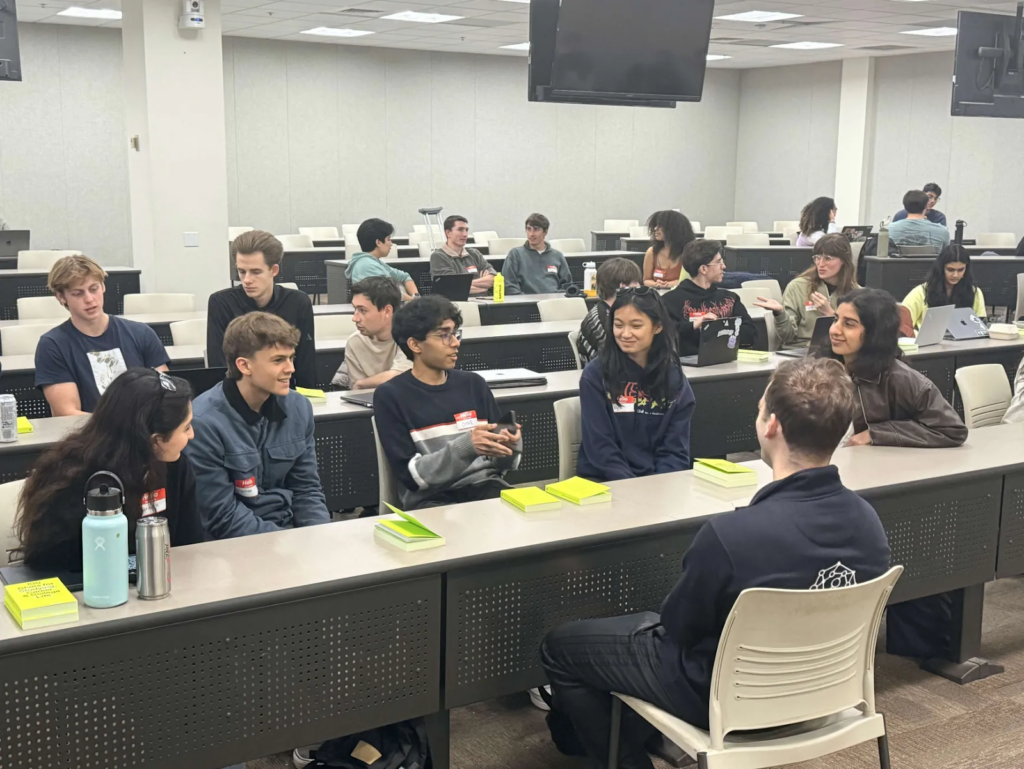
PolyPrompt brought together 70 students from diverse majors, backgrounds and skill levels, grouped intentionally into balanced, cross-disciplinary teams with one goal: to build an AI-powered product that helps students.
Supported by OpenAI and co-hosted by CS+AI and CodeBox, the weekend was designed not simply as a hackathon but as a structured opportunity for students to explore how AI can responsibly address real challenges in student life. Participants were selected through a competitive application process and placed into preassigned teams to ensure diversity in perspective and technical strength. Each team operated with defined roles and clear expectations, reinforcing disciplined product development rather than unstructured experimentation.


A Structured Weekend of Building
Friday night kicked off with guest speakers from OpenAI and Docusign highlighting innovation in agentic AI and how to get the most out of it. Teams were then formed and began refining their ideas with clear problem definitions and product direction.
Saturday began with practical workshops, equipping teams with concrete tools and implementation strategies to jump-start development. Participants then spent the remainder of the weekend crafting solutions tailored to students in one of three tracks: studying, career or college life.
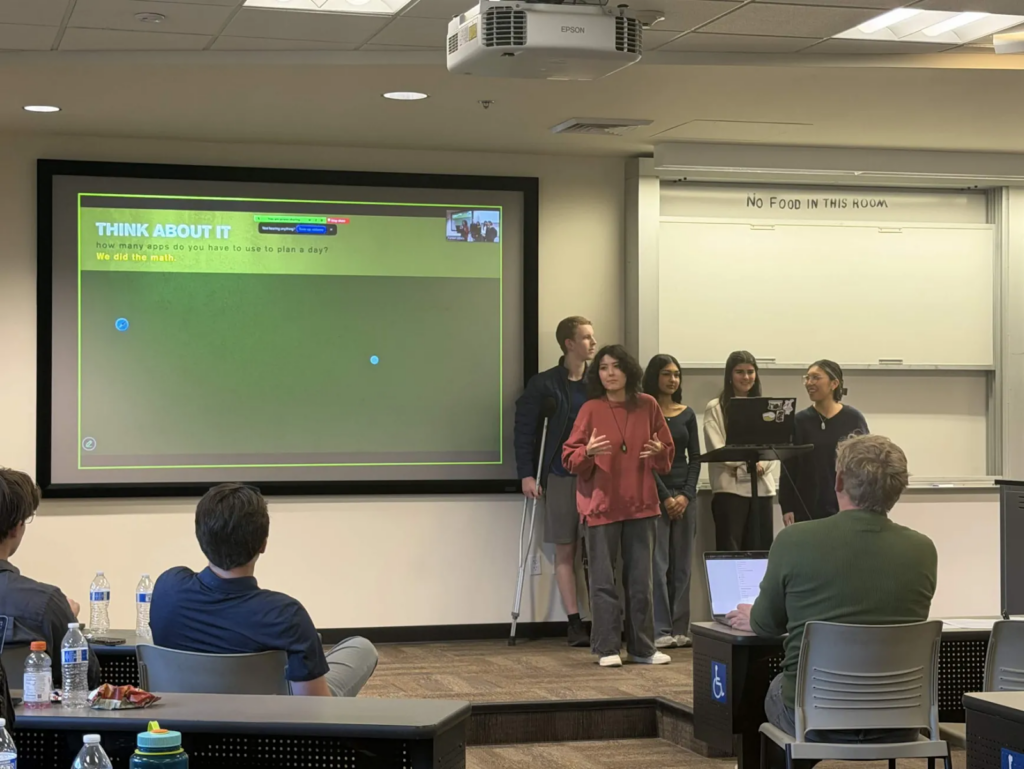
On Sunday afternoon, teams presented their products, showcasing innovative AI integration, strong product stories and ethical considerations. Seven judges from different professions and industries evaluated projects based on technical excellence, real-world impact and creative use of AI. The top three teams were determined by raw score.
1ST PLACE
GURT (Generative University Revision Tool)
Built by Jonah Chan, Mason Lewis, Alexios Sideris, Katie Slobodsky, Daniel Erazo, Isaac Tsai
GitHub | Presentation
GURT is an AI-powered study companion for students who use Canvas, designed to streamline studying by automatically turning scattered class content into flashcards, practice exams,and personalized study plans. It syncs directly with Canvas to track deadlines and ingests materials such as syllabi and slides, providing targeted practice using retrieval-augmented generation, orRAG,to ensure accurate, context-grounded assistance.
The team was driven by a simple but universal frustration: Study tools exist, but they aren’t unified. As tech lead Jonah Chan explained, “Study resources are scattered across the internet and difficult to organize in one place.”
Instead of building just another standalone tool, the team focused on deep integration and seamless collaboration between systems. Reflecting on the development process, the team shared, “It reshaped how we think about building software, with AI as a core collaborator.”
Developed using parallel Codex agents and a coordinated AI stack, GURT demonstrates how thoughtful AI integration can simplify and enhance the way students prepare for exams, stay organized,and master course content.


2ND PLACE
Starly
Built by Matthew Phan, Hannah Bratten, Matthew Lin, Scott Eisenberg, Nicholas Cao, Namish Mannepalli
GitHub | Deployed Application
Starly is an AI-powered mock interview platform tailored specifically for computer science students aiming to bridge the gap between technical skill and interview performance. The app realistically simulates hiring interviews, offering immediate, nuanced feedback using speech recognition, text-to-speech synthesis and facial expression analysis.
The inspiration came from personal experience. As the team put it, “Technical problems can be practiced on platforms like LeetCode, but there’s no equivalent tool for practicing live interview communication.”
Their goal was to build something like “LeetCode for interviews,”focused not on solving problems silently, but on speaking clearly, structuring answers and building confidence.
Beyond the technology, the team emphasized the human element. Reflecting on their collaboration, they shared, “It genuinely felt like one cohesive team rather than six individuals working separately.”
Built with an integrated stack leveraging OpenAI, Vercel and real-time audio-visual processing, Starly exemplifies the positive and practical use of AI to help students identify and strengthen their interviewing skills in a supportive, low-pressure environment.


3RD PLACE
PolyJarvis

Built by Jason Michaeloff, Ceyanna Badyal, Faith Seddon, Julia Lu, Kalani Sterling
GitHub | Presentation
PolyJarvis helps students simplify planning their days by bringing together local events, study sessions and social meetups in one intuitive app. Designed first for Cal Poly, it uses AI to recommend personalized activities, coordinate schedules with friends and streamline event creation through tools such as an automated scheduling bot and reservation assistant.
The team identified a familiar frustration: coordinating schedules across multiple apps. As they explained, “Planning usually involves sending screenshots, checking multiple apps and going back and forth trying to find a time that works.”
Their solution was to centralize everything into one streamlined experience. Reflecting on the weekend, the team shared, “The teamwork … that shared effort made the experience fun and memorable.”
Built thoughtfully with a tech stack that includes Figma, OpenAI’s Codex, fine-tuned GPT models and Supabase, PolyJarvis demonstrates how AI can support students in organizing their time, balancing productivity and downtime and navigating college life more smoothly.

Looking Ahead
PolyPrompt reflects the Noyce School of Applied Computing’s commitment to student-led innovation, structured product development and responsible AI integration. The weekend demonstrated not only technical capability, but also thoughtful design, ethical awareness and meaningful collaboration across disciplines.
Noyce is proud of all the students who participated in PolyPrompt and contributed to a weekend defined by initiative, rigor and responsible innovation.
An interview with Parker, the event’s organizer, will be published later this week.